
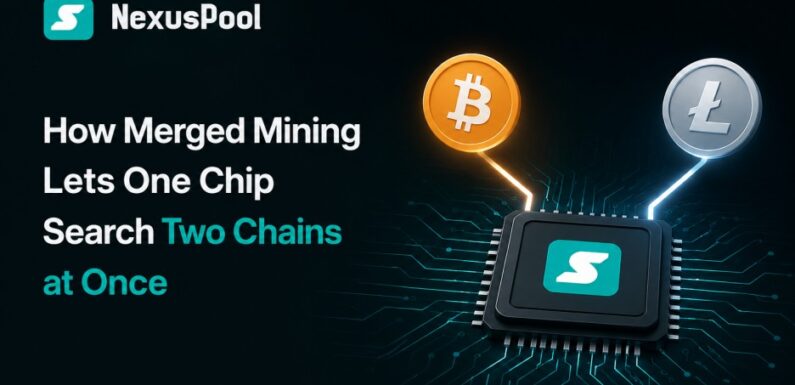
Litecoin and Dogecoin miners have access to something Bitcoin miners don’t: the ability to search for a block on both chains simultaneously from the exact same proof-of-work effort. This is called merged mining, or AuxPoW, and it’s worth understanding how it actually works rather than just knowing it exists as a feature.
The core idea
Both chains use the same hashing algorithm, Scrypt, which means the same physical mining hardware can work on both simultaneously. Merged mining takes advantage of that shared algorithm: a miner constructs a block for the “parent” chain, in this pairing Dogecoin, and embeds a commitment to that work inside the coinbase transaction of a block being built for the “auxiliary” chain, Litecoin. A single Scrypt hash is then computed and checked against both chains’ difficulty targets independently. If it clears Litecoin’s target, that’s a Litecoin block. If it separately clears Dogecoin’s, usually much lower, target, that’s a Dogecoin block. Occasionally a hash is lucky enough to clear both.
Why this isn’t a shortcut or a trick
It’s tempting to describe merged mining as getting something for nothing, but it’s more accurate to say it eliminates genuine waste. Without merged mining, a miner would have to choose between dedicating hashrate to Litecoin or to Dogecoin, splitting their search capacity across two chains that happen to use identical hardware. Merged mining removes that false choice: since the hardware is doing effectively the same computational work either way, checking the result against two targets instead of one adds negligible overhead while meaningfully increasing the odds of finding something on at least one of the two chains.
The commitment structure that makes it verifiable
The mechanism that ties the two chains together is a specific 44-byte commitment inserted into the coinbase scriptSig, tagged with a recognizable marker, which cryptographically links the auxiliary chain’s block header to the parent chain’s coinbase. This isn’t a trust-based arrangement between pool operators. It’s a structural, verifiable link: anyone can check that a claimed Litecoin block was genuinely produced through legitimate proof of work also directed at Dogecoin, rather than the two claims being asserted independently and taken on faith.
What this means for a solo miner specifically
For a solo miner, merged mining effectively means one Scrypt-based rig is quietly eligible for two separate lottery drawings from the same electricity cost. It doesn’t change the underlying odds math for either chain individually, each is still governed by its own difficulty divided by your hashrate, but it does mean your hardware isn’t sitting idle on Dogecoin’s search while working Litecoin’s, or the reverse. Two independent low-probability events, checked from the same work, rather than one.
What it doesn’t do
Merged mining doesn’t merge the rewards, the difficulties, or the odds themselves. Finding a Litecoin block doesn’t make a Dogecoin block more likely on your next hash, and vice versa. Each chain’s difficulty stands entirely on its own, and each is a fully independent lottery running in parallel.
A brief note on why the marker matters
The recognizable tag inside the coinbase commitment isn’t decorative. It’s what lets any independent observer, not just the two chains’ own software, confirm a claimed AuxPoW block is genuinely linked to real proof of work on the parent chain, rather than taking a pool’s word that the two are connected. That verifiability is the entire reason merged mining is trusted infrastructure rather than an informal convention between operators.
NexusPool implements merged mining for Litecoin and Dogecoin with full AuxPoW commitment verification, so a Scrypt rig connected to it is genuinely eligible on both chains from the same work. The same worker connects to NexusPool’s combined Litecoin and Dogecoin pool without needing any separate setup for the second chain. Free, non-custodial software, not an investment, and no reward on either chain is ever guaranteed.
Trust nothing. Verify the AuxPoW commitment yourself if a pool claims to support merged mining.
About NexusPool: NexusPool is free, non-custodial software that lets Scrypt miners solo mine Litecoin and Dogecoin through one merged mining connection, with each block’s AuxPoW commitment checked before it counts toward either chain. Connection details are posted at NexusPool’s merged mining pool.
