

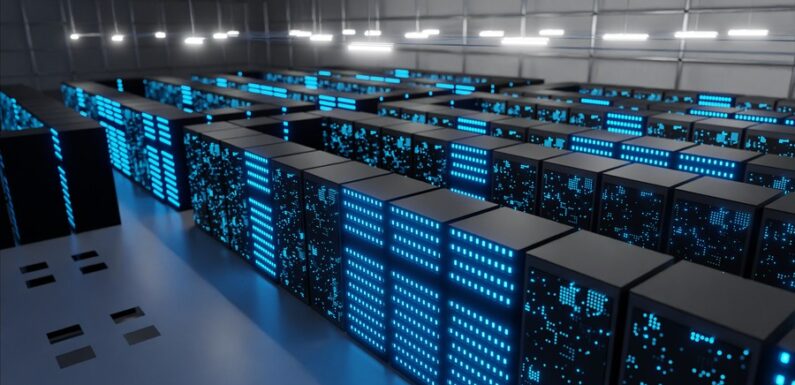
The term “AI factory” has moved quickly from industry conference talk into everyday planning conversations. It sounds like marketing, but it describes a real shift in how computing facilities are designed, powered, and cooled. Understanding the difference between an AI factory and a traditional data center helps explain why so many organizations are rethinking their infrastructure.
An AI factory is a purpose-built facility designed to run as one large compute cluster for training and deploying AI models. Instead of hosting a mix of unrelated applications, it focuses on getting the most output from a large pool of GPUs. Here is how that goal changes almost everything about the facility.
The Factory Idea
A traditional data center is a building that stores and runs IT equipment for many different applications. An AI factory behaves more like a production plant. Data and compute go in, and trained models and AI outputs come out.
That framing explains why the facility is designed around a single purpose. Every decision, from the electrical system to the cooling loop, is made to keep a large cluster busy and productive.
Different Workloads, Different Demands
Traditional data centers support a wide range of workloads, from web servers to databases to storage. These workloads are varied and rarely all peak at once, so designers can size systems based on average, diversified demand.
AI training works differently. A large cluster of GPUs often ramps up together, drawing peak power at the same moment. That means an AI factory has to be sized for the synchronous peak rather than the average. This affects:
- Uninterruptible power supplies: They must handle sudden, large swings in load.
- Switchgear and distribution: Equipment has to be rated for concentrated, simultaneous demand.
- Utility connections: The grid interconnection has to support much larger and less predictable loads.
Density Changes Everything
AI hardware packs far more computing power into each rack than conventional servers. Higher power per rack means more heat in a smaller space, and rack densities can climb well beyond what air cooling can handle.
For many high-density deployments, direct-to-chip liquid cooling becomes necessary, because liquid carries heat away much more effectively than air. Some of the latest AI servers are built with little or no reliance on fans, which moves much of the thermal burden to the facility’s liquid cooling infrastructure.
Comparing the Two
- Purpose: Traditional data centers host mixed workloads, while AI factories focus on large-scale training and inference.
- Power design: Traditional sites size for diversified average load, while AI factories size for synchronous peak load.
- Cooling: Air cooling is often enough in traditional sites, while AI factories frequently need liquid cooling.
- Rack density: Traditional racks run at modest densities, while AI racks can be many times higher.
- Downtime tolerance: AI training runs can last days or weeks, so an interruption can be costly.
- Operating model: AI factories manage a lifecycle from model training and fine-tuning through ongoing inference.
The Full AI Lifecycle
An AI factory is not only about training. After a model is trained and refined, it moves into inference, where it answers questions and performs tasks based on new data. As models become more autonomous, inference can run continuously and generate value around the clock.
That ongoing activity means the facility has to remain reliable for years, not just during a single large training project.
Why Reliability Matters So Much
A single power or cooling failure can interrupt a training job that has been running for weeks. For that reason, AI factories often rely on condition-based maintenance, which uses real-time monitoring and analytics to service equipment when it needs attention, rather than on a fixed schedule. The goal is to catch problems early and keep the cluster running.
Challenges Operators Face
Building an AI factory is not simple. Common challenges include:
- Power availability: Securing enough electricity for large clusters.
- Cooling: Moving heat out of dense racks efficiently.
- Networking: Connecting thousands of GPUs with very high-speed links.
- Cybersecurity and data privacy: Protecting valuable models and data.
- Cost and efficiency: Getting the most useful output from each dollar and each watt.
- Skills: Finding people who understand both IT and facility engineering.
What This Means for Planning
Organizations considering AI infrastructure should treat power, cooling, and layout as core design questions from the start rather than afterthoughts. Retrofitting a traditional facility for high-density AI can be difficult, and early planning helps avoid costly changes later.
Industry groups like the Uptime Institute publish research on reliability and facility design that can help with planning.
A New Category of Infrastructure
An AI factory is not simply a bigger data center. It is a different kind of facility, built around concentrated power, advanced cooling, and continuous operation. As AI workloads grow, the line between the two will keep becoming clearer, and the organizations that understand the difference will be better prepared to build for it.
